Midwinter: Where Handwritten Warmth Meets Modern Design
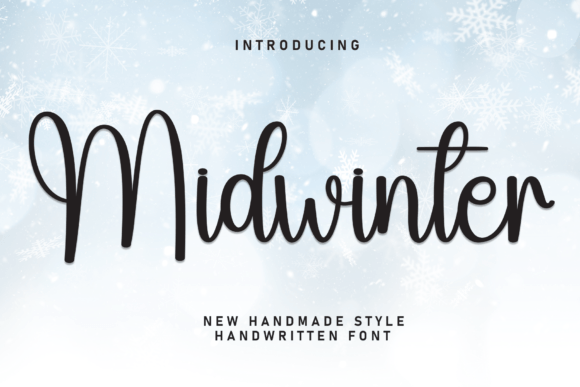
There’s a quiet shift happening across digital and print design—one that favors authenticity over uniformity, warmth over sterility, and intention over automation. In this context, Midwinter isn’t just another script font. It’s a thoughtful response to how people now experience visual communication: less as passive viewers, more as emotionally engaged participants. Midwinter is a sweet and cursive handwritten font—soft in stroke, confident in flow, and deeply human in character. Its gentle curves and subtle irregularities echo the rhythm of ink on paper, not the precision of an algorithm. That distinction matters more than ever.
Why Handwritten Fonts Are Resonating Now
After years of minimalist interfaces, rigid grids, and ultra-thin sans-serifs dominating branding and web design, many creators are turning toward type that feels *lived-in*. This isn’t nostalgia for its own sake—it’s a functional recalibration. Studies in visual cognition show that moderately irregular, hand-drawn forms increase perceived approachability and trust, especially in contexts involving care, creativity, or personal connection—think wellness brands, independent bookshops, wedding stationery, or educator-led online courses.
Midwinter fits squarely into this evolution. Unlike highly stylized or overly decorative scripts, it balances legibility with personality. Its lowercase ‘g’ and ‘y’ have soft descenders; its capitals rise with quiet confidence—not flamboyant, but memorable. That makes it versatile: equally at home on a Shopify product label, a Canva social post, or a printed workshop workbook. It doesn’t shout. It invites.
From Trend to Tool: How Midwinter Fits Real Workflows
Designers and non-designers alike are using tools like Figma, Adobe Express, and even Google Slides more fluidly than ever—and many of those platforms now support variable fonts and OpenType features out of the box. Midwinter includes standard ligatures and alternate glyphs, meaning users can access subtle variations (like a swash capital or a connected ‘st’ pair) without switching apps or installing plugins. That lowers the barrier between idea and execution.
Consider a freelance educator launching a new mindfulness course. She could use Midwinter for her course title slide, pairing it with a clean, neutral sans-serif (like Inter or Lato) for body text. The contrast does two things: it signals emotional resonance where it counts (the headline), while preserving readability where it’s needed most (instructions, schedules, takeaways). No design degree required—just intentionality.
Similarly, small business owners managing their own Instagram or email newsletters often face a tension: stand out visually, but don’t alienate. Midwinter adds charm without sacrificing clarity. A bakery owner might use it for “Hand-Mixed Brioche” in a carousel post—keeping the rest of the caption in a simple system font. The result feels curated, not cluttered.
Not Just for “Cute”—A Font With Range
It’s easy to mislabel Midwinter as purely “romantic” or “whimsical,” but that underestimates its adaptability. Its joyful tone comes from rhythm and spacing—not exaggerated flourishes. That gives it surprising range across tone and industry.
- A sustainable fashion brand might use Midwinter for limited-edition collection names (“Winter Solstice Edit”), grounding eco-conscious messaging in tactile, human-centered typography.
- A therapist building a private practice website could apply it sparingly—to the tagline (“Where Healing Begins”)—to soften clinical language without undermining professionalism.
- An indie publisher designing a poetry chapbook might set the author’s name and chapter titles in Midwinter, letting the verses breathe in a modest serif like Merriweather.
The key isn’t using Midwinter everywhere—it’s using it where warmth amplifies meaning. Overuse dilutes impact; thoughtful placement reinforces voice.
What’s Changed in How We Choose Type
Fifteen years ago, font licensing was fragmented, file formats were inconsistent, and web performance concerns meant designers avoided custom scripts entirely. Today, variable font files compress efficiently, services like Google Fonts and Adobe Fonts offer one-click activation, and browsers render OpenType features reliably—even on mobile. That means Midwinter works as well in a responsive email template as it does in a PDF invitation.
More importantly, audiences have grown more typographically literate. They notice when a brand’s typeface feels mismatched—when a fintech startup uses a bubbly script for its security dashboard, or when a law firm chooses something too casual for client contracts. Midwinter avoids those pitfalls by being expressive *without* being unserious. Its weight distribution and x-height are calibrated for screen legibility at medium sizes, and its letterforms retain integrity even when scaled down to 18px for mobile buttons or badges.
Practical Tips for Getting Started
You don’t need a full rebrand to begin exploring Midwinter. Start small—and intentionally:
- Test contrast first. Pair it with a neutral, highly readable sans-serif (e.g., Manrope, Work Sans, or IBM Plex Sans). Avoid other scripts or decorative fonts in the same layout—they’ll compete rather than complement.
- Reserve it for hierarchy. Use Midwinter for headlines, quotes, section dividers, or callouts—not long paragraphs or data tables. Its strength lies in emphasis, not endurance.
- Check licensing early. Midwinter is available through reputable foundries with clear commercial licenses. If you’re using it for client work, verify usage rights for web, app, and print outputs upfront—especially if embedding in software or SaaS products.
- Think beyond color. While Midwinter shines in warm tones (terracotta, oat, deep plum), it also holds up beautifully in charcoal gray or navy—proving its versatility isn’t dependent on pastel palettes.
Looking Ahead: Typography as Quiet Advocacy
As AI-generated visuals flood feeds and templates proliferate, the value of intentional, human-made choices rises—not as decoration, but as quiet advocacy for care, slowness, and individuality. Midwinter reflects that ethos. It doesn’t try to be everything. It asks to be used where emotion matters: in the note tucked inside a gift, the welcome message on a learning platform, the sign hanging outside a neighborhood studio.
This isn’t about rejecting efficiency. It’s about recognizing that some messages—especially those tied to identity, belonging, or transition—deserve texture. Midwinter provides that texture without demanding attention. It supports the content instead of overshadowing it. And in an era where people scroll faster but remember less, that kind of respectful presence is increasingly rare—and increasingly valuable.
Whether you're drafting your first newsletter, refining a brand guideline, or simply choosing a font for a personal project, consider what tone you want to extend before you extend the invitation. Midwinter won’t solve every design challenge—but when warmth, sincerity, and gentle joy are part of the brief, it’s a choice that lands with quiet certainty.