Sunday in Adelaide: A Handwritten Font That Anchors Design in Warmth and Confidence
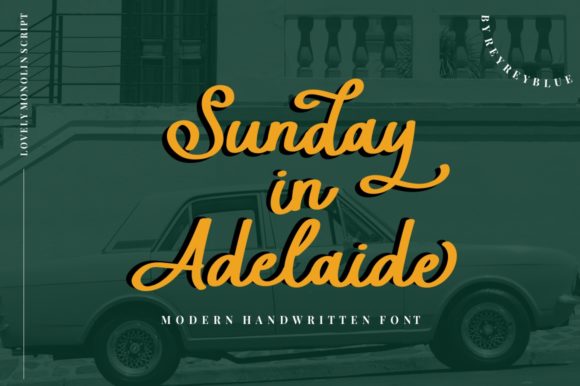
Typography is rarely just about legibility—it’s about resonance. When a font carries voice, rhythm, and emotional texture, it stops being a tool and becomes a collaborator. Sunday in Adelaide is one such collaborator: a sweet, brushed handwritten typeface with unmistakable retro charm and quiet authority. It doesn’t shout—but when it speaks, people lean in. Its strokes are soft yet deliberate, its curves generous but never indulgent, and its rhythm feels both spontaneous and carefully composed—like handwriting that’s been practiced until it becomes second nature.
What Makes Sunday in Adelaide Distinctively Retro—and Why That Matters Today
Retro typography isn’t merely nostalgic decoration. It taps into cultural memory—evoking the tactile warmth of hand-painted signage, mid-century magazine spreads, vintage postcards, and analog album covers. But Sunday in Adelaide avoids pastiche. It doesn’t mimic 1950s script or 1970s psychedelia; instead, it distills their spirit into something contemporary and usable. The brush-like contrast—thick downstrokes paired with fine, tapered upstrokes—lends kinetic energy. Letters tilt slightly forward, suggesting motion and intention. The spacing is open and generous, allowing each character to breathe without sacrificing cohesion.
This balance is what makes the font feel both grounded and dynamic. Unlike many handwritten fonts that risk looking overly casual or decorative, Sunday in Adelaide reads as strong and confident—not because it’s bold or aggressive, but because its forms are assured. There’s no hesitation in the entry strokes or exit flourishes. That confidence translates directly into design applications where authenticity and presence matter: brand identities seeking approachability without dilution, editorial features needing personality without distraction, or packaging aiming for handmade sincerity in a mass-produced landscape.
Where Sunday in Adelaide Finds Its Strongest Footing
Not every font thrives across contexts—and Sunday in Adelaide is no exception. Its strengths shine brightest where human expression matters more than mechanical precision. Consider these real-world applications:
- Brand storytelling: Cafés, bookshops, local breweries, and artisanal studios often choose Sunday in Adelaide for logos or wordmarks. Its warmth signals care and craft, while its structural clarity ensures recognition at small sizes—say, on a ceramic mug or a woven tote bag tag.
- Editorial emphasis: In long-form digital or print journalism, designers use it sparingly—for pull quotes, section headers, or introductory lines—to add tonal depth. One publication used it for recurring “Voices from the Community” sidebars, instantly distinguishing personal narrative from reported text.
- Educational materials: Teachers and curriculum designers have adopted it for classroom posters, student-facing worksheets, and digital learning modules—particularly in early literacy or creative writing units. Its friendly yet structured appearance supports readability while gently reinforcing the idea that handwriting is expressive, not just functional.
- Event identity: From indie film festivals to neighborhood garden fairs, Sunday in Adelaide appears in posters, tickets, and social media banners. Its retro inflection subtly cues “thoughtful curation,” while its legibility holds up on phone screens and printed flyers alike.
It’s less suited for dense body copy, legal disclaimers, or interfaces demanding strict typographic neutrality—but that’s by design. Like choosing watercolour over vector graphics, selecting Sunday in Adelaide is a decision to foreground tone and texture over uniformity.
Practical Considerations for Real-World Use
Adopting any display font requires attention to context, hierarchy, and technical execution. With Sunday in Adelaide, three considerations consistently emerge across professional workflows:
Pairing with Supporting Typefaces
Because it’s a display face, Sunday in Adelaide benefits from thoughtful companionship. Designers most commonly pair it with clean, humanist sans-serifs (e.g., Inter, Lato, or Work Sans) or low-contrast serifs (Merriweather, Crimson Text). The contrast between its organic flow and their measured geometry creates visual harmony—not tension. Avoid pairing it with other highly decorative or high-contrast scripts; doing so risks visual competition rather than complementarity.
Weight and Size Sensitivity
The font includes a single weight—intentionally. Its strength lies in its consistency, not versatility. At large sizes (48pt and up), its brushwork sings. At smaller sizes (below 24pt), some details—like subtle tapering or delicate crossbars—may soften on lower-resolution screens. For digital use, test rendering across devices: it performs exceptionally well on modern Retina displays but may require slight letter-spacing adjustments on older Android browsers.
Language and Character Support
Sunday in Adelaide covers Latin-based languages comprehensively—including extended diacritics for French, Spanish, German, and Scandinavian languages. It supports ligatures for common pairs like “fi”, “fl”, and “ff”, which enhance rhythm in longer words. However, it does not include Cyrillic, Greek, or East Asian character sets. Teams working on multilingual projects should plan fallbacks or complementary fonts for non-Latin sections.
How Designers Are Integrating Sunday in Adelaide Into Modern Workflows
In practice, adoption goes beyond aesthetics—it reflects evolving attitudes toward authenticity in digital spaces. A growing number of web developers now embed Sunday in Adelaide via variable font-friendly services (like Google Fonts’ alpha program or self-hosted WOFF2 files), using @font-face declarations with appropriate font-display: swap settings to ensure fast loading and graceful fallbacks.
For motion designers, its natural flow lends itself to animated reveals—especially in explainer videos or social-first content. One educational nonprofit animated the font’s letters “inking in” stroke-by-stroke to introduce each chapter of a climate literacy series, turning typography into narrative punctuation.
Print professionals appreciate its OpenType features: contextual alternates that prevent repetitive letterforms in consecutive words, and swash variants for initial capitals. These aren’t gimmicks—they’re subtle refinements that elevate professionalism without demanding extra effort.
Why Sunday in Adelaide Resonates Beyond Aesthetics
In an era saturated with algorithmically generated visuals and AI-assisted layouts, Sunday in Adelaide offers something increasingly rare: evidence of human hand and considered intent. Its imperfections—slight variations in stroke width, gentle inconsistencies in baseline alignment—are not flaws. They’re signatures of craft. That’s why educators use it to model expressive writing for students, why researchers cite it in studies on visual trust in health communication, and why small business owners choose it when they want their brand to say, “We made this ourselves.”
Its retro style isn’t escapist—it’s anchoring. In times of rapid technological change, fonts like Sunday in Adelaide ground digital experiences in tangible, relatable humanity. They remind users that behind every interface, campaign, or publication is a person—or a team—making deliberate, empathetic choices.
Getting Started Thoughtfully
If you’re considering Sunday in Adelaide for an upcoming project, begin with restraint. Start by applying it to one high-impact element: a logo, a headline, or a call-to-action button. Observe how it changes perception—not just visually, but emotionally. Does it make your message feel more inviting? More trustworthy? More distinct?
Then, test across environments. Print a sample on uncoated paper. View it on a mobile screen in daylight. Ask colleagues or target users what tone they associate with it—not “what does it look like?” but “how would you describe the person or organisation using this?” Their answers will reveal whether the font aligns with your intended voice.
Finally, consider longevity. Trends fade, but well-chosen typography endures. Sunday in Adelaide has already appeared in award-winning branding systems, nationally distributed publications, and community-led initiatives spanning five years—and its relevance shows no sign of diminishing. That staying power stems not from novelty, but from integrity: every curve, every angle, every space was drawn with purpose.
A Font That Doesn’t Just Sit on the Page—It Stands Beside You
Ultimately, Sunday in Adelaide functions less like a static asset and more like a design partner. It asks questions: What feeling do you want to extend to your audience? Where does warmth strengthen clarity? How can confidence be expressed without rigidity?
It won’t solve layout problems or replace strategic thinking—but when aligned with intention, it deepens connection. Whether you’re a teacher designing a reading poster, a startup founder refining a brand manifesto, or a researcher preparing a public-facing summary of complex findings, Sunday in Adelaide offers a voice that’s both familiar and freshly resonant: unhurried, human, and quietly sure of itself.