Fresh Fruits: Where Handwritten Elegance Meets Modern Design Utility
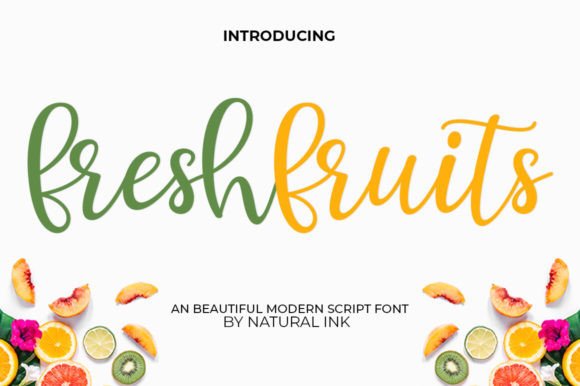
Typography is rarely neutral—it carries tone, intention, and cultural resonance before a single word is read. Among contemporary script fonts, Fresh Fruits stands apart not because it shouts, but because it breathes: soft yet confident, organic yet precise, effortlessly elegant without sacrificing legibility. It’s not merely a “handwritten” font; it’s a carefully calibrated visual language designed for moments that matter—weddings, milestones, quiet affirmations, and brand identities rooted in authenticity.
More Than Aesthetic: The Craft Behind the Curve
What distinguishes Fresh Fruits from generic script fonts is its intentional balance of human imperfection and typographic discipline. Each glyph features subtle variation in stroke weight, gentle tapering at terminals, and a rhythmic baseline that mimics natural handwriting—but with consistent spacing, harmonious x-heights, and carefully tuned kerning pairs. Unlike overly flourished scripts that sacrifice readability at small sizes, Fresh Fruits maintains clarity even at 14pt in body text or on mobile screens.
This precision emerges from deliberate design choices: the lowercase ‘a’ and ‘g’ use classic single-story forms for openness; the capital ‘Q’ includes a graceful, unobtrusive tail rather than an aggressive swirl; and ligatures (like ‘fi’, ‘fl’, ‘ct’) are included but opt-in—preserving editorial control. These aren’t decorative afterthoughts. They’re functional responses to real-world constraints: print resolution, screen rendering, accessibility contrast, and multilingual character support (including extended Latin characters used across Western European languages).
Context Is King: Where Fresh Fruits Earns Its Place
A font doesn’t succeed in isolation—it succeeds where it solves a problem. Fresh Fruits thrives in contexts demanding warmth without informality, distinction without distraction. Consider these scenarios:
- Wedding Stationery: Invitations set the emotional temperature for an entire event. Here, Fresh Fruits conveys sincerity and celebration simultaneously—its gentle curves echo handwritten vows, while its even rhythm ensures names and dates remain dignified and legible against textured paper or foil-stamped backgrounds.
- Brand Identity Systems: Small businesses—from artisanal bakeries to boutique wellness studios—use Fresh Fruits in logos not to appear “cute,” but to signal care, craft, and human-scale values. Paired with a clean sans-serif for supporting text (e.g., Fresh Fruits for “Haven Apothecary”, Inter for “Botanical Skincare Since 2018”), it creates hierarchy with empathy.
- Educational & Inspirational Materials: Teachers printing classroom quotes, researchers designing conference posters, or nonprofit communicators crafting donor thank-you cards all benefit from typography that feels personal yet professional. Fresh Fruits lends gravitas to phrases like “Your voice matters” or “Curiosity is the first step”—without veering into cloying sentimentality.
- Digital Interfaces with Heart: While not intended for UI body text, Fresh Fruits excels in micro-interactions: a custom loading message (“Just one moment…”), a celebratory banner after form submission (“Thank you! We’ll be in touch”), or a signature line in email footers. These touches humanize digital experiences often dominated by rigid geometry.
Practical Integration: Beyond Drag-and-Drop
Adopting Fresh Fruits effectively requires more than selecting it from a dropdown. Real-world implementation involves thoughtful layering:
Pairing With Purpose
Script fonts gain strength through contrast. Fresh Fruits pairs exceptionally well with humanist sans-serifs (like Lato or Nunito) and low-contrast serifs (such as Cormorant Garamond or Playfair Display). Avoid clashing energy—don’t pair it with another high-contrast script or a geometric sans like Futura. The goal isn’t visual competition; it’s complementary roles: Fresh Fruits for emotion and identity, the secondary font for structure and information.
Color & Contrast Considerations
Its elegance relies on sufficient contrast. On light backgrounds, deep charcoal (#333333) or true black works best—avoid light greys that mute its delicate strokes. For dark backgrounds, use crisp off-whites (#f8f8f8) rather than pure white, which can cause glare and reduce legibility. Always test color combinations using WCAG 2.1 contrast checkers, especially when used for accessible signage or digital assets.
Responsive Behavior
While primarily a display font, Fresh Fruits scales gracefully from large-format prints (think 24”x36” event posters) down to 18pt headings on tablets. However, avoid using it below 16pt in digital interfaces or smaller than 10pt in print—its subtlety dissolves at tiny sizes. For responsive websites, define Fresh Fruits in CSS with fallbacks: font-family: "Fresh Fruits", "Segoe Script", cursive; ensures graceful degradation if the web font fails to load.
Who Benefits Most—and Why
Fresh Fruits serves a surprisingly wide spectrum of users—not because it’s universally applicable, but because its strengths align with specific, recurring needs across disciplines:
- Creative Professionals (graphic designers, lettering artists): Value its OpenType features—stylistic alternates, swashes, and contextual ligatures—for customizing headlines without manual redrawing. Its vector precision makes it ideal for laser-cut signage or embroidery digitization.
- Educators & Trainers: Use it to create visually warm learning materials that reduce cognitive load—students recall information better when presented in aesthetically coherent, non-distracting formats. A syllabus header in Fresh Fruits, for instance, signals approachability without compromising authority.
- Small Business Owners: Gain immediate visual differentiation in crowded markets. A café menu with Fresh Fruits for dish names and a clean sans for descriptions feels curated, not generic—communicating attention to detail that customers associate with quality.
- Researchers & Nonprofits: Leverage its emotional resonance in grant proposals or impact reports. When describing community stories or qualitative findings, Fresh Fruits in pull quotes or section dividers subtly reinforces humanity-centered methodology.
- Hobbyists & DIY Enthusiasts: Appreciate its ease of use in platforms like Canva or Adobe Express. Pre-built templates featuring Fresh Fruits lower the barrier to creating polished, personal artifacts—birth announcements, memory books, or handmade gift tags—without design training.
Limitations Worth Acknowledging
No tool is universal—and recognizing boundaries strengthens responsible usage. Fresh Fruits is intentionally unsuited for certain applications:
- Long-form reading: Its connected, flowing nature slows scanning. Never use it for paragraphs, legal disclaimers, or instructional manuals.
- High-density data visualization: Axis labels, legends, or annotations require neutrality and speed of recognition—Fresh Fruits introduces unnecessary cognitive friction here.
- Brands emphasizing tech-forward or industrial aesthetics: A cybersecurity firm or aerospace startup would undermine its messaging by choosing a font rooted in organic, tactile sensibility.
- Non-Latin scripts: As of current releases, Fresh Fruits does not include Cyrillic, Greek, or extended Asian language support. Projects requiring multilingual typesetting need supplemental fonts.
Evolution in Action: From Print Tradition to Digital Fluidity
Historically, script fonts lived on engraved invitations and hand-lettered shop signs—static, physical, labor-intensive. Fresh Fruits bridges that heritage with digital fluency. Its file structure supports variable font technology (in updated versions), allowing designers to adjust weight and width dynamically—making one font file serve multiple expressive needs. This adaptability reflects broader trends: modern typography increasingly prioritizes flexibility, sustainability (fewer font files), and context-aware behavior.
Moreover, its popularity among educators and therapists points to an emerging understanding of typography’s psychological role. Studies in environmental psychology suggest that rounded, soft-edged typefaces like Fresh Fruits can subconsciously reduce perceived stress and increase approachability—valuable insights for healthcare communications, mental wellness apps, or inclusive classroom environments.
Final Thought: Typography as Intentional Stewardship
Choosing Fresh Fruits is rarely about chasing trend—it’s about stewarding attention. In a world saturated with algorithmic feeds and templated content, a font that invites pause, suggests care, and honors the weight of human connection becomes quietly radical. It reminds us that every design decision, no matter how small, participates in shaping how messages land—not just what they say, but how they’re felt. Whether guiding guests to a garden wedding, welcoming students to a new semester, or introducing a local maker’s story to the world, Fresh Fruits offers a vocabulary of elegance that never overshadows the meaning it carries.