Snowback: Where Timeless Calligraphy Meets Modern Design Sensibility
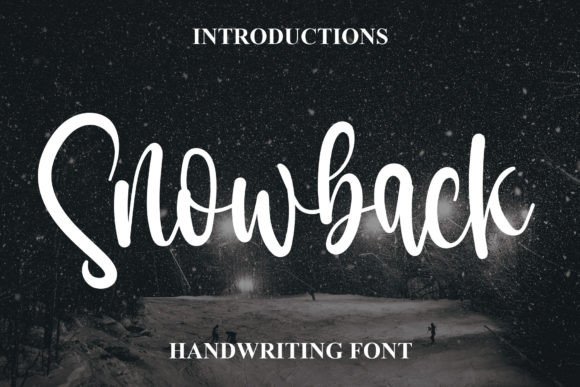
Typography isn’t just about legibility—it’s about voice, mood, and intention. When you choose a font, you’re choosing a collaborator for your message. That’s why Snowback stands out: it’s not merely a handwritten typeface, but a carefully calibrated expression of elegance, rhythm, and quiet confidence. Designed with reverence for classic calligraphy yet grounded in contemporary design needs, Snowback bridges heritage and immediacy—making it a compelling choice for creatives who refuse to sacrifice sophistication for usability.
A Handwritten Font That Doesn’t Feel “Handwritten”
Many script fonts lean too far into whimsy or informality—think chalkboard doodles or over-embellished flourishes that distract rather than elevate. Snowback avoids those pitfalls entirely. Its strokes flow with natural variation—subtle thicks and thins, gentle entry and exit terminals—but never at the expense of clarity or consistency. There’s no forced quirkiness. No exaggerated swashes competing for attention. Instead, Snowback offers balanced letterforms, thoughtful spacing, and intelligent alternates that respond gracefully to context.
This restraint is intentional. The designers studied historical broad-nib penmanship—not to replicate it, but to internalize its logic. The result? A font that feels both hand-crafted and digitally precise. You’ll notice how lowercase g and y carry graceful descenders without overwhelming line height, or how uppercase S and C balance openness and structure. These aren’t accidents—they’re decisions made to serve real-world use cases.
Where Snowback Fits Naturally—and Why It Works So Well
Snowback thrives where tone matters as much as text. It’s especially effective in branding contexts that prioritize authenticity, craftsmanship, or mindful luxury—think boutique skincare labels, independent book publishers, artisanal food packaging, or wedding stationery that whispers rather than shouts.
- Editorial design: Used sparingly for pull quotes or chapter headings, Snowback adds warmth and narrative texture without compromising readability in body copy set in a complementary serif or sans-serif.
- Digital interfaces: While not intended for long-form UI text, Snowback shines in hero sections, email headers, or onboarding screens where personality and emotional resonance are strategic assets.
- Print collateral: Its high x-height and generous counters ensure crisp rendering even at smaller sizes on premium paper stocks—ideal for business cards, letterheads, or limited-run posters.
What makes Snowback particularly adaptable is its built-in versatility. It includes stylistic sets, contextual alternates, and ligatures that activate automatically in OpenType-savvy applications (like Adobe Illustrator, InDesign, or Affinity Designer). Turn on discretionary ligatures, and words like “love” or “forever” gain subtle, organic connections—never gimmicky, always refined.
Practical Considerations Before You Commit
Before licensing Snowback, consider how it will function—not just how it looks. Here’s what experienced designers often weigh:
- Weight and contrast range: Snowback is offered in a single, thoughtfully tuned weight. That’s by design—not limitation. It’s optimized for impact at display sizes (18pt and up), so if your project demands bold, light, or condensed variants, you’ll want to pair it intentionally with a neutral supporting type family.
- Language support: It covers Latin-based languages comprehensively—including extended diacritics for French, Spanish, German, and Scandinavian tongues. If you’re designing for multilingual markets beyond those, verify glyph coverage early.
- Licensing scope: Snowback offers clear, tiered licensing—web, desktop, app embedding, and unlimited-use options. For agencies managing multiple client projects, the multi-seat or extended license often delivers better long-term value than piecemeal purchases.
Also worth noting: Snowback performs best when given room to breathe. Tight tracking or aggressive all-caps settings can erode its nuanced rhythm. Let it shine in title case or sentence case, with generous letter-spacing where needed. Think of it less as a workhorse and more as a soloist—brilliant in the right spotlight, supported wisely elsewhere.
Pairing Snowback With Purpose
No font exists in isolation—and Snowback reveals its full potential when paired with intention. Its contemporary atmosphere pairs beautifully with clean, humanist sans-serifs like Inter, Clash Grotesk, or Work Sans. These combinations create visual hierarchy without tension: Snowback brings warmth and character; the sans-serif grounds the layout with neutrality and function.
For print-heavy projects—say, an artisan coffee brand’s seasonal catalog—you might set product names in Snowback, descriptions in a warm serif like Sorts Mill Goudy, and technical details in a compact monospace. Each layer communicates something distinct: craft, story, and specificity.
On the web, pairing becomes even more critical. Because Snowback is a display font, it should never be used for navigation menus or paragraph text. But as a headline font loaded via @font-face with appropriate font-display: swap, it enhances perceived quality without sacrificing performance—especially when served in modern WOFF2 format.
Real Projects, Real Results
A Portland-based ceramics studio recently relaunched its website using Snowback for logo lockups and collection titles. They paired it with IBM Plex Sans for body text and captions. Feedback from customers? “It feels like the pieces themselves—thoughtful, tactile, quietly confident.” That alignment between typography and brand essence is exactly what Snowback enables.
Another example: a literary magazine redesigned its cover series around Snowback’s expressive ascenders and descenders. By adjusting baseline shifts slightly and using alternate glyphs for recurring author initials, each issue gained individuality while maintaining series cohesion. Readers began recognizing the subtle typographic signature before even reading the title.
Why Snowback Feels Like the Right Choice—Right Now
In an era saturated with algorithmically generated fonts and AI-assisted design tools, Snowback reminds us of the irreplaceable value of human judgment in type design. Every curve was drawn, tested, and refined—not predicted. Its imperfections are intentional. Its consistency is earned.
That doesn’t mean it’s difficult to use. Quite the opposite: because its proportions and spacing were engineered for real applications—not theoretical ideals—it integrates smoothly into modern workflows. Whether you’re exporting SVG logos in Figma, prepping files for letterpress printing, or building a Shopify theme, Snowback behaves predictably and renders cleanly across devices and platforms.
And perhaps most importantly, Snowback respects the viewer’s time and attention. It doesn’t shout. It doesn’t distract. It invites pause—just long enough for meaning to settle.
If your next project calls for a voice that’s both distinctive and trustworthy—if you need typography that carries weight without heaviness, personality without pretense—Snowback isn’t just an option. It’s a considered, capable, and quietly exceptional one.