Hello Stefanie: The Handwritten Font That Feels Like a Warm Invitation
There’s something quietly powerful about handwriting — the subtle tilt of a letter, the gentle swell of a curve, the confident flick of a terminal. It conveys personality before a single word is read. Hello Stefanie captures that human warmth with remarkable fidelity. It’s not just another script font; it’s a carefully crafted, expressive typeface designed to feel personal, intentional, and effortlessly elegant.
More Than Just Pretty Letters
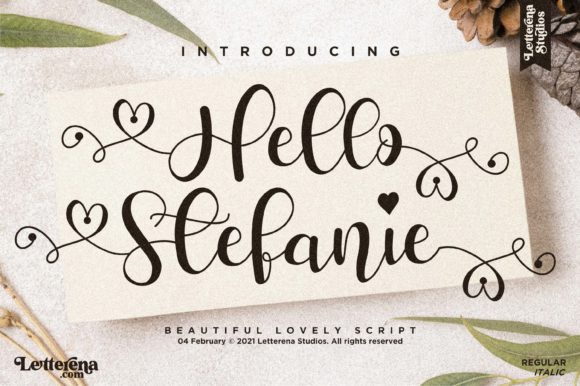
At its core, Hello Stefanie is a timeless handwritten font — one that avoids the overly ornate or artificially “quirky” tendencies some scripts fall into. Its strokes flow with natural rhythm, balancing consistency and variation in a way that mimics real pen-on-paper movement. The lowercase ‘a’, for instance, has a soft, open bowl and a graceful entry stroke. The capital ‘S’ curves with confidence but never shouts. Even punctuation feels considered — commas and periods sit with quiet intention, not afterthought.
This authenticity is why designers reach for Hello Stefanie when they need more than decoration. They need resonance. A wedding invitation doesn’t just announce a date — it sets a mood. A boutique skincare brand doesn’t just list ingredients — it invites trust. A quote shared on Instagram isn’t just text — it’s a moment of connection. In each case, Hello Stefanie acts as a visual handshake: warm, sincere, and memorable.
Why Designers Choose Hello Stefanie for Logos & Branding
Logos live at the intersection of identity and recognition. They must be distinctive enough to stand out, yet refined enough to scale across business cards, websites, and signage. Hello Stefanie excels here because it offers both character and clarity. Unlike ultra-thin or excessively flourished scripts, it maintains legibility even at smaller sizes — especially when used thoughtfully (e.g., pairing a bold version for headlines with a lighter weight for subtext).
- Perfect for lifestyle brands: Think artisanal coffee roasters, handmade ceramics studios, or mindful wellness coaches — businesses whose values center around care, craft, and human connection.
- Ideal for editorial accents: Use it sparingly in magazine layouts for pull quotes or section headers to add texture without overwhelming clean typography systems.
- Strong in digital spaces: When optimized properly (via webfont kits or variable font exports), Hello Stefanie renders beautifully on screens — no pixelation, no awkward spacing.
It’s also highly adaptable. Pair it with a crisp sans-serif like Montserrat or Inter for contrast that feels modern yet grounded. Or layer it with a soft serif like Playfair Display for a romantic, editorial tone. Its versatility means it doesn’t lock you into one aesthetic — it elevates whatever context it enters.
The Practical Power of PUA Encoding
Here’s where Hello Stefanie moves beyond aesthetics into serious workflow efficiency: it’s PUA encoded. That stands for Private Use Area — a technical feature many users overlook, but one that makes all the difference when working with rich, expressive fonts.
In short, PUA encoding means every alternate glyph, swash, ligature, and stylistic flourish lives in its own dedicated slot within the font file. No complex OpenType panels. No guessing which key combination triggers which variation. Just select the character, open your glyph panel (in Illustrator, Photoshop, or Affinity apps), and click. Want a dramatic descending ‘y’? It’s there. A looping ‘t’ crossbar? Available. An elegant initial capital with an extended flourish? One click away.
This matters most when time is tight and precision matters. Imagine designing a monogram for a client’s stationery suite. With Hello Stefanie, you can quickly cycle through five different ‘S’ options to find the one that best balances with their surname’s first letter — all without switching fonts or installing extras. Or building a quote graphic for social media: swap in a decorative ampersand or a custom bullet point to break up text rhythm — instantly, consistently, reliably.
Real-World Usage Tips
Like any expressive tool, Hello Stefanie shines brightest when used with purpose — not just because it’s beautiful, but because it serves the message.
- Less is more: Reserve full swashes for hero text — headlines, logos, or featured quotes. Overuse dilutes impact and risks visual noise.
- Watch letter spacing: Handwritten fonts often benefit from slight tracking adjustments. Tighten for intimacy (e.g., a small tagline); loosen slightly for readability in longer phrases.
- Test across mediums: Print samples on your intended paper stock — matte vs. glossy changes how ink spreads, affecting fine details. On screen, preview at multiple sizes and backgrounds (light/dark mode matters).
- Consider licensing early: Hello Stefanie is available in desktop, web, and app licenses. If you’re building a client’s website or mobile app, confirm the license covers your use case — especially for dynamic text rendering.
Fitting Into Modern Creative Workflows
Today’s designers juggle speed, scalability, and soulfulness — often simultaneously. Tools like Figma, Canva, and Adobe Express demand fonts that load fast, embed cleanly, and behave predictably. Hello Stefanie meets those demands while retaining its hand-drawn charm. Its well-hinted outlines ensure crisp rendering, and its thoughtful metrics prevent awkward gaps or collisions between letters.
For freelancers, it’s a quiet differentiator. When presenting three logo concepts, the one using Hello Stefanie often stands out — not because it’s flashier, but because it feels *human*. Clients sense that intention. For in-house teams, it becomes a reliable asset in brand guidelines: a go-to for expressive moments that still align with voice and values.
Even non-designers benefit. Teachers crafting classroom posters, authors designing book interiors, or small-business owners updating their Etsy banners — all find Hello Stefanie approachable. You don’t need advanced typography knowledge to use it well. A little attention to hierarchy and spacing goes a long way.
What Makes Hello Stefanie Timeless — Not Trendy
Trends come and go — think of the hyper-realistic brush scripts of the early 2010s or the ultra-minimalist monoline styles that dominated mid-decade. Hello Stefanie avoids chasing fads. Instead, it draws from enduring qualities: balance, warmth, restraint, and craftsmanship.
Its x-height is generous, supporting readability. Its contrast between thick and thin strokes is present but moderate — enough to suggest pen pressure, not so much that it fractures at small sizes. There are no forced “imperfections” added for effect; the slight irregularities feel earned, like the natural variation in real handwriting.
That’s why it works just as well in a 2024 rebrand as it would have in a 2014 boutique launch — or, likely, in a 2034 anniversary campaign. Timelessness isn’t about being bland. It’s about being rooted in fundamentals that resonate across eras.
If you’re selecting a font for something meant to last — a logo, a signature product line, a personal manifesto — Hello Stefanie earns its place not just as a visual choice, but as a quiet promise of sincerity.