Easter Story: A Handwritten Font with Quiet Confidence
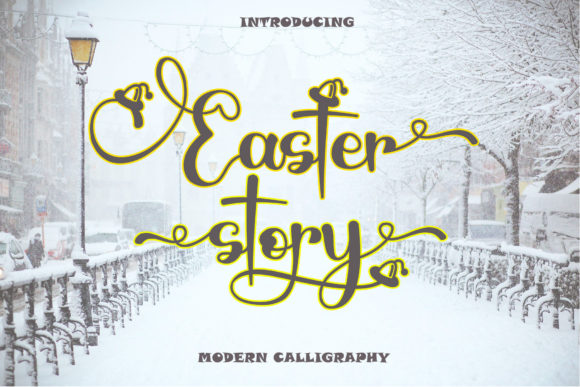
If you’ve ever held a wedding invitation that made you pause—just for a breath—before opening it, you know the power of the right type. Easter Story is that kind of font: not loud, not flashy, but deeply intentional. It’s a premium script font designed with the quiet confidence of ink on fine paper—slight contrast in stroke weight, graceful entry and exit strokes, and subtle swashes that feel earned, not tacked on. There’s warmth in its curves and precision in its spacing. It doesn’t shout “handwritten!”—it simply *is*, with elegance that reads as both personal and polished.
Where Easter Story Earns Its Place
This isn’t a font for body text or data tables. Easter Story shines as a display font—ideal where personality and intention matter most. Think wedding invitations where names are centered and tenderly set; thank-you cards that land with sincerity, not sterility; boutique packaging that whispers craftsmanship before the box is even opened. It works beautifully in editorial design for pull quotes or chapter headings, lending literary grace without pretension. On social media graphics—especially for lifestyle brands, florists, or artisan bakers—it adds tactile authenticity amid digital noise.
It also holds its own in logo design for businesses rooted in care and craft: a ceramic studio, a small-batch candle maker, a family-run bookstore, or a mindful wellness practice. Because Easter Story avoids the overly ornate or cutesy, it supports brand identity without overwhelming it. You’re not choosing a gimmick—you’re choosing a tone. And that tone says: considered, human, unhurried.
More Than Aesthetic: How It Shapes Perception
Typefaces shape how people feel before they even read a word. With Easter Story, that feeling is grounded in trust and warmth. Its handwritten quality signals approachability—but its refined proportions and consistent rhythm keep it from reading as casual or amateurish. That balance directly influences brand perception: a small business using it thoughtfully signals professionalism *and* personality, not one or the other.
In print, its generous x-height and open counters ensure legibility at 18pt and above—even on textured cotton paper. Digitally, it performs best in high-resolution contexts (SVG logos, static social banners, PDF invites) rather than dynamic web text, where variable fonts or system fonts remain more practical. As part of a broader brand system, Easter Story excels when paired with a clean, neutral sans serif—think a restrained geometric like Poppins or a warm humanist like Lato—for contrast that feels natural, not forced. The pairing creates visual hierarchy without friction: Easter Story draws the eye; the sans serif delivers clarity.
Testing Fit Before You Commit
Before licensing Easter Story, ask two practical questions: *What’s the emotional weight of this project?* and *Who needs to feel seen by it?* If your audience values authenticity over polish—or if your brand thrives in quiet moments of connection—this font aligns. But if your work lives in fast-paced digital feeds, technical documentation, or environments demanding instant scannability, it may slow things down unnecessarily.
Test it early—not just in mockups, but in real context. Paste a line into your actual invitation layout. Print a sample on your chosen paper stock. Try it at three sizes: 24pt (headline), 16pt (subhead), and 12pt (fine print—though we’d recommend avoiding it here). Notice where spacing tightens or swashes collide. Easter Story includes PUA encoding, so every alternate glyph, ligature, and swash is accessible directly from your glyph panel—no workarounds needed. That means you can refine rhythm and flow precisely, which matters most in tight spaces like business cards or monogrammed tags.
Also review what’s included. Most licenses for Easter Story cover the full set: standard characters, discretionary ligatures, initial and terminal swashes, and stylistic alternates. Some versions include matching catchwords or flourishes—useful for packaging or book covers, less so for minimalist logos. Check whether your license permits web embedding (via @font-face) or only desktop use. For bloggers or marketers embedding quotes in Squarespace or WordPress, confirm compatibility first.
Real Pairings, Real Results
A designer friend recently used Easter Story for a local apothecary’s rebrand—pairing it with a light-weight serif (Cormorant Garamond) for product labels and a crisp sans (Inter) for website navigation. The result? Shelves that felt curated, not crowded; an online shop that balanced heritage and usability. No one commented on the fonts—but several customers mentioned how “calm” and “trusted” the branding felt.
Another example: a wedding stationery suite where Easter Story handled names and dates, while a soft, low-contrast sans (like Quicksand Light) carried details like RSVP instructions and accommodation notes. The contrast wasn’t dramatic—but it was effective. Guests intuitively knew where to look first, and the overall impression remained cohesive, not cluttered.
These aren’t theoretical pairings. They reflect how Easter Story functions in practice: as a quiet anchor, not a solo act. It gains strength from restraint—and gives back more when surrounded by thoughtful design choices.
A Final Note on Licensing and Longevity
Easter Story is a commercial font, meaning it requires a license for any use tied to business, promotion, or revenue—even if you’re a solo crafter selling handmade goods on Etsy. Free alternatives rarely match its nuance, and using unlicensed fonts risks takedowns or legal exposure, especially in client work. Reputable sellers provide clear terms: desktop, web, app, and e-book licenses are often sold separately. If you’re building templates for resale (Canva, Creative Market), verify extended licensing—it’s not always included by default.
Think of Easter Story as a long-term design asset—not a seasonal trend. It won’t chase algorithm shifts or platform updates. Instead, it deepens over time: the more consistently it appears across touchpoints (a logo, a tagline, a handwritten note inside a package), the more it becomes synonymous with your voice. That kind of recognition isn’t built in a day. But with Easter Story, it starts with a single, well-placed letter.