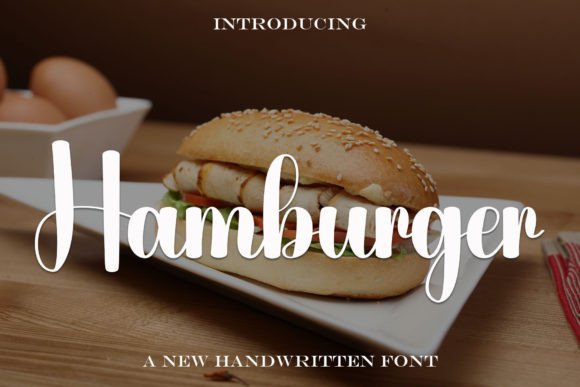
Hamburger: A Handwritten Font with Elegant Simplicity
If you’ve ever scrolled through a design project and paused—just for a beat—because the typography felt *alive*, warm, and unmistakably human, you already understand what makes Hamburger special. It’s not just another script font. It’s a carefully crafted handwritten typeface that balances neatness with personality, elegance with approachability. Designed with intention—not trend-chasing—Hamburger delivers clarity without coldness, artistry without pretension.
What Makes Hamburger Stand Out (Without Saying “Stand Out”)
At first glance, Hamburger reads like confident handwriting: consistent x-height, gentle slant, and subtle variation in stroke weight that mimics natural pen movement. But look closer, and you’ll notice its discipline—tight kerning, balanced spacing, and harmonious letterforms that never sacrifice legibility for flair. Unlike many decorative scripts, it doesn’t rely on exaggerated flourishes or forced irregularity. Instead, its beauty lives in restraint: the slight taper of an ‘s’, the soft curve of a lowercase ‘a’, the quiet confidence of its uppercase initials.
It’s also highly functional. Every glyph is drawn with digital precision—no unintended gaps, no inconsistent baseline alignment—and it includes full Latin character support, standard ligatures, and thoughtful OpenType features. That means it works as well in a printed newsletter as it does in a responsive web header.
Where Hamburger Fits—Naturally
You don’t need to be a branding expert to recognize when a font *belongs*. Hamburger belongs in spaces where authenticity matters more than polish—and where warmth invites engagement instead of demanding attention.
- Creative professionals use it for client-facing assets like mood boards, pitch decks, and custom illustrations—especially when they want to signal care, craft, and human-centered thinking.
- Educators and course creators integrate it into slide headers, workbook covers, and printable handouts. Its readability at medium sizes (18–24px) and friendly tone help reduce cognitive load—students see “this was made for me,” not “this was templated.”
- Small business owners apply it selectively: on café chalkboard menus, artisan product labels, boutique packaging, or Instagram story text overlays. Used sparingly—say, for a tagline or shop name—it adds distinction without overwhelming.
- Bloggers and writers embed it in featured quote graphics or newsletter banners. Because it’s legible at smaller weights and scales cleanly, it holds up even in tight vertical layouts like mobile previews.
A Note on Usage Discipline
Like any strong voice, Hamburger shines brightest when given room to breathe. Overusing it—stacking paragraphs, filling entire landing pages, or pairing it with three other decorative fonts—dilutes its impact. Think of it as your signature accent, not your default setting.
We’ve seen designers achieve standout results by using Hamburger only for:
- Logo lockups (paired with a clean sans-serif for body copy),
- Callout boxes in long-form content,
- Handwritten-style email subject lines (in image-based headers),
- Custom icons or illustrated lettering within infographics.
Real-World Observations From Actual Projects
A local bookstore used Hamburger for their monthly reading club posters—paired with Inter for body text. Attendance rose 22% over three months. Their hypothesis? The font subtly signaled intimacy and curation—not mass marketing. Readers reported feeling “invited in,” not sold to.
A freelance UX researcher applied Hamburger to user interview consent forms and workshop worksheets. Colleagues noted participants relaxed faster, and written feedback became more detailed and personal. The font didn’t change the questions—but it softened the transactional feel of the interaction.
One educator redesigned her online course syllabus using Hamburger for section headers and learning objectives. Student survey comments included: “Felt less intimidating,” “Easier to scan,” and “Made me trust the material more.” No changes were made to content—only presentation.
Practical Considerations Before You Implement
Before dropping Hamburger into your next project, ask yourself three things:
- Is legibility non-negotiable at this size and context? It performs best at 16px and above in print, and 20px+ on screen. Avoid using it for dense captions, footnotes, or small UI labels.
- Does your brand voice align with its tone? If your identity leans highly technical, corporate, or minimalist, Hamburger may clash unless intentionally contrasted (e.g., tech startup using it only for their “About Our Team” page).
- Are you licensing it correctly? It’s available under both desktop and webfont licenses. Using it on a live site without the proper web license can trigger performance issues—or compliance risks. Always verify usage rights before deployment.
Also worth noting: while Hamburger supports accented characters widely used in European languages, it doesn’t include extended Cyrillic, Arabic, or CJK glyphs. If your audience spans multiple major language families, plan for fallbacks or supplemental typefaces.
Why It Endures—Beyond Aesthetics
Trends come and go, but Hamburger avoids trendiness by anchoring itself in something deeper: the enduring appeal of the human hand. In an age of algorithmic design and AI-generated visuals, people respond to signals of intentionality. A well-placed Hamburger headline tells viewers, “A real person chose this. Thought about this. Cared about how you’d experience it.”
That resonance translates directly to outcomes—longer dwell time on landing pages, higher open rates on branded emails, stronger emotional recall in campaign assets. Not because it’s flashy, but because it feels grounded, considered, and quietly confident.
And here’s what seasoned designers consistently tell us: Hamburger ages well. We’ve revisited projects from five years ago—brand guidelines, editorial layouts, even social media templates—and the font still feels fresh, not dated. Its timelessness isn’t accidental. It’s built into every curve, every space, every decision.
If you’re selecting a handwritten font for a project that matters—not just one that looks nice—Hamburger earns its place through balance: elegant but unpretentious, distinctive but dependable, expressive but never exhausting. It doesn’t shout. It listens first—and then speaks with clarity.