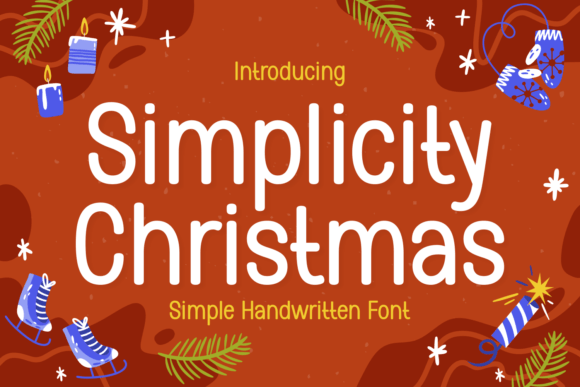
Simplicity Christmas: A Handwritten Holiday Font
There’s a quiet power in handwriting — the slight variation in stroke weight, the gentle tilt of letters, the way ink seems to breathe on paper. Simplicity Christmas captures that warmth without overcomplicating it. It’s not ornate or fussy. It’s not overly decorative or difficult to read. Instead, it’s a clean, flowing script designed with intention: to feel personal, seasonal, and effortlessly inviting.
This isn’t just another holiday font dropped into a marketplace and forgotten. Simplicity Christmas was built around real use — for people who design greeting cards at home, craft small-batch packaging, draft heartfelt newsletters, or build cozy brand moments online. Its lowercase letters connect smoothly, its capitals carry presence without dominance, and its spacing allows text to rest comfortably — whether printed on kraft paper or displayed on a mobile screen.
Why Simplicity Christmas Works Where Others Don’t
Many festive fonts lean too hard into tradition — think heavy swashes, snowflake ligatures, or exaggerated flourishes that distract from the message. Others go so minimal they lose all seasonal character. Simplicity Christmas strikes a balance: it reads like something you’d write yourself, but with refined consistency and subtle holiday rhythm.
That balance makes it unusually versatile. You can scale it large for a banner without losing legibility. You can set it small in a thank-you note and still preserve its handmade charm. And because it avoids extreme contrast or tight kerning, it pairs naturally with clean sans-serifs (like Montserrat or Inter) or soft serifs (like Lora or Cormorant Garamond) — ideal for layered layouts in Canva, Adobe Express, or Figma.
Creative Uses That Feel Authentic, Not Forced
Think beyond “Merry Christmas” banners. Simplicity Christmas shines when it supports human-centered communication — not decoration for decoration’s sake.
- Small business holiday packaging: Stamp your return address or a short note (“Packed with care in Portland”) directly onto shipping labels or gift tags. The font feels personal, not automated — reinforcing trust and attention to detail.
- Educator classroom materials: Use it for reading passages about winter traditions, student name tags for holiday projects, or printable certificates (“Winter Wonder Reader”). Its clarity helps young readers follow along while keeping the tone warm and inclusive.
- Email subject lines and newsletter headers: In crowded inboxes, a subtle handwritten touch stands out — but only if it’s legible. Simplicity Christmas works well at 22–28px in email clients and renders cleanly across devices.
- Social media story overlays: Add a quick caption like “Our last day open before break!” or “Hand-poured + wrapped with love” to product shots or team photos. Its rhythm guides the eye without competing with imagery.
Adapting It Thoughtfully Across Contexts
A font doesn’t work the same way everywhere — and Simplicity Christmas is no exception. Here’s how different users can adjust usage for impact and clarity:
Designers & marketers: Limit Simplicity Christmas to one typographic role per layout — usually headlines, quotes, or short calls-to-action. Avoid body copy. Pair it with a highly legible secondary font for supporting text. Test printouts at actual size: what looks elegant on screen may blur slightly on uncoated paper.
Bloggers & educators: Use it sparingly in featured image text — for example, a Pinterest-friendly quote graphic (“The best gifts aren’t wrapped”) — but keep blog post titles and headings in a more scalable web font. This keeps your site fast and accessible while still adding seasonal texture where it matters most.
Hobbyists & small shop owners: Print test sheets on your intended paper stock first. Simplicity Christmas performs especially well on textured cardstock and matte finishes, where its soft edges echo natural fiber. Avoid glossy surfaces unless you’re laser-printing — inkjet on gloss can feather slightly.
Keeping Your Work Clear, Consistent, and Audience-Friendly
Even the most charming font can undermine your message if used inconsistently. To keep Simplicity Christmas effective:
- Stick to two weights maximum: Most versions include Regular and Bold. Use Bold only for emphasis — never for full paragraphs. Reserve Regular for most headline and short-text applications.
- Maintain generous line height: At 16–18px size, aim for 1.4–1.6 line height. This prevents letters from visually crowding, especially in tighter containers like Instagram captions or email footers.
- Test readability early: Ask someone unfamiliar with your project to read a sample aloud. If they hesitate on letterforms (e.g., confusing “a” and “o”, or misreading “rn” as “m”), simplify the layout — reduce background texture, increase contrast, or tighten the copy.
- Respect platform limits: On platforms like Etsy or Shopify, Simplicity Christmas should be embedded as webfont only where supported (via @font-face), or converted to outlines for static images. Never assume all buyers have it installed.
Real Projects, Real Results
A Portland-based candle maker uses Simplicity Christmas for batch numbers stamped onto soy wax lids — “Batch 23-W” — giving each product a quietly artisanal signature. No extra branding needed; the font itself signals care and seasonality.
An elementary school teacher in Ohio prints Simplicity Christmas on laminated “Kindness Cards” students give each other during December. The soft curves make the act feel tender, not performative — and kids recognize it instantly as “our holiday writing.”
A freelance copywriter includes Simplicity Christmas in her holiday service package — not for her client-facing deliverables, but in the PDF proposal cover page and thank-you note. It subtly reinforces her brand voice: warm, skilled, and human-first.
None of these uses require advanced typography knowledge. They rely instead on thoughtful placement, restraint, and alignment with audience expectations.
Getting Started Without Overthinking It
You don’t need a design degree to use Simplicity Christmas well. Start with one small application this season: a printed tag for a hostess gift, a header in your December newsletter, or a single line on your website banner. Notice how it changes the tone — not by shouting “CHRISTMAS!”, but by whispering “I made this for you.”
Then ask: Does it support the message? Is it easy to read in context? Does it feel true to who you are or who you serve? If yes, expand thoughtfully. If not, adjust spacing, size, or pairing — not the font itself.
Simplicity Christmas isn’t about perfection. It’s about presence. It’s the difference between sending a card and sending a feeling — and sometimes, that’s exactly what your audience remembers long after the tree comes down.