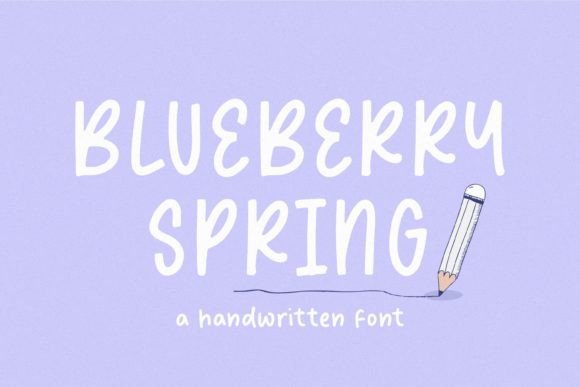
Blueberry Spring: A Handwritten Font with Heart
Imagine opening a notebook and seeing words that feel like they were written just for you — not typed, not templated, but thoughtfully, warmly, humanly composed. That’s the quiet power of Blueberry Spring: a handwritten font designed not to mimic perfection, but to echo presence. It doesn’t shout. It leans in. And for creators who value authenticity over automation, it often becomes the subtle yet decisive detail that changes how a message lands.
Why Handwriting Still Matters — Even Digitally
In an age of AI-generated text and algorithm-driven design, handwriting carries rare weight. It signals intention. It implies time taken, care extended, attention paid. Blueberry Spring captures that essence without requiring pen or paper. Its letters flow with natural variation — slight shifts in stroke weight, gentle entry and exit tails, soft curves that avoid mechanical repetition. Unlike many script fonts that rely on rigid ligatures or overly ornate flourishes, Blueberry Spring stays legible at small sizes and remains expressive at larger ones. It’s handwriting refined, not rehearsed.
Where Blueberry Spring Fits Naturally
This isn’t a font for corporate reports or legal disclaimers — and it shouldn’t be. Its strength lies in contexts where warmth and individuality are assets, not distractions:
- Personal journals and digital notebooks: When using apps like Notion or Obsidian, pairing Blueberry Spring with minimalist layouts creates space for reflection — not just recording, but reconnecting with your own voice.
- Educational handouts and lesson notes: Teachers report students respond more positively to materials that feel approachable. A worksheet title or quote in Blueberry Spring can soften academic tone without sacrificing clarity.
- Small business branding touches: Think thank-you cards, product tags, or Instagram story overlays for local bakeries, bookshops, or wellness studios. It adds tactile familiarity in a scrolling world — like a signature on a receipt, not a logo on a billboard.
- Quote graphics and mindful content: Bloggers and newsletter writers use Blueberry Spring for excerpted lines from poetry, interviews, or personal essays. The rhythm of its letterforms mirrors the cadence of thoughtful speech.
Not Just Pretty — Purposefully Designed
Legibility was prioritized from the start. Letters like “a”, “g”, and “r” avoid ambiguous shapes common in decorative scripts. The lowercase “s” has a clear terminal; the “t” crosses with gentle confidence. That means readers don’t pause to decode — they absorb. This matters especially in longer passages, such as journal prompts or reflective email newsletters, where emotional resonance depends on effortless reading.
Spacing is also tuned for real-world use. Kerning pairs (like “To”, “We”, or “love”) have been adjusted so words breathe naturally, not clump. You won’t need to manually nudge characters in Canva or Figma just to make a phrase look balanced — a small time-saver that adds up across dozens of designs.
Who Benefits Most — And Why
Freelancers and solopreneurs often juggle brand consistency with personal tone. Blueberry Spring helps them bridge that gap: a proposal header in a clean sans-serif, followed by a warm closing note in Blueberry Spring, signals both professionalism and personality.
Educators and therapists find it useful for creating inclusive, low-pressure materials. One school counselor shared how switching from Arial to Blueberry Spring on printed coping strategy cards made students more likely to pick them up — “It didn’t feel like homework. It felt like something someone wrote down because they wanted me to read it.”
Bloggers and content creators focused on mental health, creativity, or slow living use Blueberry Spring to visually reinforce their values. It’s not about looking “artsy” — it’s about signaling that what follows is meant to be felt, not skimmed.
When to Pause — And Consider Alternatives
Like any tool, Blueberry Spring has context-sensitive limits. It’s not ideal for body text in long-form web articles, accessibility-focused documents (where high-contrast, highly legible fonts remain essential), or multilingual projects requiring extensive diacritic support — its current language coverage centers on English, Western European, and basic punctuation.
If your work regularly involves tight deadlines and minimal design time, test Blueberry Spring early in your workflow. Some users prefer pairing it with a neutral companion font (like Inter or Lato) rather than trying to force it into every role. A headline in Blueberry Spring + paragraph in a clean sans-serif often delivers more impact than uniform styling.
A Thoughtful Starting Point
You don’t need to overhaul your entire toolkit to benefit from Blueberry Spring. Try it in one intentional place this week: the subject line of a personal email, the title of your next journal entry, the caption beneath a photo in your portfolio. Notice how it changes the tone — not dramatically, but meaningfully. That’s the hallmark of good typography: it doesn’t draw attention to itself. It draws attention to you, and to what you’re saying.
Fonts like Blueberry Spring matter because they remind us that communication isn’t just about transmitting information — it’s about sharing perspective, inviting connection, and honoring the human behind the words. In a digital landscape increasingly shaped by speed and scale, choosing a handwritten font is a small, deliberate act of slowness. Of care. Of showing up — fully, gently, authentically.
That’s why designers, educators, writers, and small business owners return to Blueberry Spring again and again: not for novelty, but for nuance. Not for decoration, but for depth.