Huf: The Handwritten Font That Bridges Personality and Professionalism
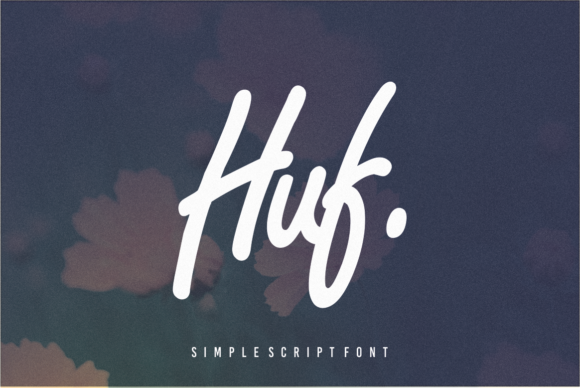
Typography is rarely neutral. Even the most restrained sans-serif carries subtle cultural cues—clean lines suggest efficiency; tight spacing implies precision; generous letterforms evoke openness. But few typefaces communicate warmth, authenticity, and human intention as directly as Huf. Designed as a simple, cursive, and casual paint-brushed handwritten font, Huf doesn’t simulate handwriting—it embodies it. Its strokes breathe with the slight irregularity of a brush moving across paper: tapered entry points, organic exit flourishes, gentle contrast between thick downstrokes and thin upstrokes. It’s not overly ornate, nor does it strive for calligraphic perfection. Instead, Huf lands in that rare middle ground where approachability meets intentionality—making it uniquely suited to contexts where credibility and connection must coexist.
What Makes Huf Distinctive—Beyond “Handwritten”
Not all handwritten fonts are created equal. Many fall into one of two traps: either they’re too rigid—digitally traced scripts that feel sterile and rehearsed—or too chaotic—overly expressive fonts that sacrifice legibility for flair. Huf avoids both extremes. Its design philosophy centers on restraint and rhythm. Each character maintains consistent x-height and baseline alignment, ensuring readability at small sizes (as low as 14px in print or 16px on screen). Yet its brush-based construction introduces subtle variation: no two “a”s are identical in stroke weight distribution, and connecting letters flow with natural ease—not forced ligatures, but implied continuity.
This balance emerges from deliberate technical choices. Unlike vector-heavy script fonts built from geometric Bézier curves, Huf uses simplified, pressure-sensitive brush paths. That means its outlines respond gracefully when scaled or exported to SVG or variable font formats—retaining texture without pixelation. It also performs well in CSS environments where font loading and rendering consistency matter, especially in email clients or CMS-driven templates where fallback behavior is critical.
Where Huf Adds Value—Real-World Applications
Huf thrives where tone matters as much as information. Its utility isn’t confined to decorative flourishes—it solves communication problems rooted in perception and trust.
Wedding and Life-Cycle Communications
Consider wedding stationery: couples increasingly seek designs that reflect their relationship—not generic elegance, but shared history and individual voices. Huf appears frequently on save-the-dates, ceremony programs, and thank-you notes because it conveys sincerity without pretension. A couple hosting an intimate backyard wedding might pair Huf with a clean, light sans-serif for body text—using Huf only for names and dates. That contrast signals care in detail without overwhelming the layout. Educators planning milestone celebrations for students—or researchers designing acknowledgments for thesis defenses—also find Huf effective for honoring personal achievement with quiet dignity.
Greeting Cards and Small-Business Branding
Independent stationers, artisanal bakeries, and local bookshops often lack large marketing budgets—but they possess strong community ties. Huf helps them project authenticity at scale. A greeting card line using Huf for sentiment phrases (“You made my day,” “So grateful for you”) feels hand-signed even when mass-printed. Similarly, a neighborhood coffee roaster might use Huf in its logo lockup alongside a sturdy slab serif—Huf handling the tagline (“Roasted with care since 2018”) while the primary logo remains highly legible at a distance. This layered typographic strategy supports brand recognition *and* emotional resonance.
Digital Interfaces with Human Texture
Surprisingly, Huf finds thoughtful application beyond print. In educational dashboards for K–12 learning platforms, designers sometimes use Huf for motivational microcopy—“Great job!” or “Try again—you’re close!”—placed beside neutral interface elements. The font softens digital friction without undermining clarity. Likewise, nonprofit newsletters employ Huf for donor appreciation headers (“Thanks to people like you…”), subtly reinforcing relational language over transactional framing. These uses aren’t about decoration; they’re about voice modulation—shifting tone contextually within a single interface.
Who Benefits Most—from Designers to Decision-Makers
Huf serves a wider audience than just graphic designers. Its accessibility stems from how easily it integrates into existing workflows—and how intuitively its value translates across roles.
- Freelance designers appreciate Huf’s licensing flexibility and OpenType features—standard ligatures, discretionary swashes, and alternate characters allow quick customization without custom illustration.
- Small-business owners benefit from its plug-and-play usability in Canva, Adobe Express, and Squarespace—no need for advanced typography training to achieve professional-looking results.
- Educators and curriculum developers use Huf to signal “this is meant for you”—adding warmth to rubrics, feedback comments, or classroom posters without sacrificing structure.
- Researchers documenting qualitative work sometimes embed Huf in interview transcripts or participant quotes presented in reports—visually distinguishing lived experience from analytical text.
- Hobbyists and makers rely on Huf for craft labels, recipe cards, or zine covers where personality matters more than polish.
Even developers interact with Huf meaningfully. Its relatively small file size (<50 KB WOFF2) and broad browser support mean it can be safely self-hosted without compromising page speed—critical for SEO performance and Core Web Vitals compliance. When paired with appropriate @font-face declarations and fallback stacks (e.g., font-family: "Huf", "Segoe Script", cursive;), it degrades gracefully across devices and assistive technologies.
Practical Considerations Before You Use Huf
Like any tool, Huf excels when matched to the right task—and knowing its limits is part of using it effectively.
Legibility thresholds matter. While Huf remains readable at 16px on high-DPI screens, avoid using it for long-form body copy, legal disclaimers, or data tables. Its strength lies in short bursts: headlines, captions, quotes, and calls to action. For extended reading, pair it with a highly legible companion—such as Inter, Lora, or Source Serif Pro—to create visual hierarchy and cognitive relief.
Color and background contrast require attention. Because Huf’s brush texture includes fine hairlines and soft edges, low-contrast combinations (e.g., light gray Huf on off-white) can cause edge fuzziness or reduced readability. Always test against WCAG 2.1 AA standards—especially for public-facing materials. A deep charcoal (#333) or navy (#2A3B5F) on clean white typically provides optimal fidelity and accessibility.
Licensing is straightforward—but verify use case. Huf is available under standard desktop, web, and app licenses. However, if embedding in a SaaS platform where end users generate branded assets (e.g., a wedding-planning app), confirm whether your license permits dynamic font serving. Most vendors offer extended licenses for such scenarios—clarifying this upfront prevents compliance issues later.
How Huf Fits Into Broader Typographic Trends
Huf reflects larger shifts in how we understand professionalism. Ten years ago, corporate identity demanded uniformity: strict brand guidelines, rigid font hierarchies, and minimal deviation. Today, audiences reward brands that demonstrate empathy, adaptability, and contextual awareness. Huf aligns with that evolution—not as a trend-chaser, but as a functional response to demand for human-centered typography.
It’s part of a growing family of “approachable serif” and “intentional script” fonts gaining traction among mission-driven organizations: think of fonts like Playfair Display for editorial gravitas or Quicksand for friendly UI elements. Huf occupies a distinct niche within that spectrum: less formal than Playfair, more grounded than Quicksand, and far more nuanced than generic handwriting fonts bundled with operating systems.
That specificity makes it valuable for creators who reject one-size-fits-all solutions. When a university department redesigns its alumni newsletter, Huf might appear only in the “From the Dean” signature block—reinforcing personal accountability. When a mental health startup crafts onboarding emails, Huf could soften clinical terminology (“Your first session is scheduled”) without diluting professionalism. These are micro-decisions with macro-impact: building trust through typographic consistency, not conformity.
Getting Started—Without Overcomplicating
You don’t need special software or training to begin using Huf meaningfully. Start small:
- Download the font files from a reputable source—preferably the original foundry or an authorized reseller.
- Install locally and test in your preferred design tool. Try setting a single sentence in multiple weights (if available) and sizes—observe how stroke contrast changes with scale.
- Build a simple pairing: choose one neutral, highly legible font for paragraphs and reserve Huf for headings, pull quotes, or accent text.
- Print a sample at actual size—screen rendering often masks texture loss or spacing quirks visible on paper.
- Share with a colleague unfamiliar with typography and ask: “What feeling does this convey?” Their answer reveals whether your usage aligns with intent.
Huf won’t solve every design challenge. It won’t replace rigorous user research or strategic branding. But when deployed with intention—respecting its strengths, acknowledging its boundaries, and anchoring it in real human needs—it becomes more than a font. It becomes a quiet collaborator in making communication feel less like transmission, and more like connection.