Seafaring Searring: A Handwritten Font for Distinctive Design Applications
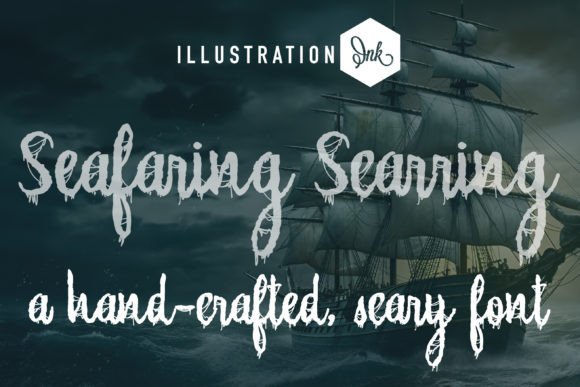
Seafaring Searring is a digitally released handwritten typeface distinguished by its fluid, organic stroke variation and intentional irregularity. It was designed to evoke the spontaneity of pen-on-paper lettering while maintaining consistent spacing and legibility across characters. Unlike calligraphic or brush-based fonts that emphasize dramatic contrast or formal structure, Seafaring Searring leans into subtle asymmetry, gentle swashes, and uneven baseline alignment—giving it a relaxed, humanized rhythm.
Designers often explore handwritten fonts like Seafaring Searring when seeking visual differentiation in branding, editorial layouts, packaging, or digital interfaces where personality and approachability matter. Its modern yet whimsical character makes it suitable for projects targeting audiences that value authenticity, creativity, or narrative depth—such as independent book covers, artisanal product labels, event invitations, or boutique web experiences.
Why Consider Seafaring Searring?
Readers evaluating fonts typically weigh expressive potential against functional constraints. Seafaring Searring stands out in contexts where typographic voice carries semantic weight. For example, a children’s book publisher might choose it to reinforce storytelling warmth; a coastal café could use it on signage to subtly reinforce a nautical, handcrafted identity. Its uniqueness lies not in novelty alone, but in how its stylistic choices support specific communicative goals—namely, evoking imagination, movement, and tactile presence.
The font includes standard Latin characters, numerals, and basic punctuation. It supports OpenType features such as contextual alternates and ligatures, which help avoid repetitive glyph patterns common in script fonts. These features contribute to more natural-looking text blocks at larger sizes, especially in headings or short phrases.
Practical Benefits and Realistic Expectations
One benefit of Seafaring Searring is its strong visual cohesion within limited-use scenarios. When applied to titles, logos, or accent text, it creates immediate distinction without requiring extensive customization. Its moderate x-height and open counters aid readability at 24–48 pt sizes, particularly on high-resolution screens or printed materials.
However, expectations should be calibrated. Seafaring Searring is not optimized for extended body text. Its variable stroke widths, slight baseline wavering, and connected letterforms reduce scanning efficiency beyond two or three lines. Users should anticipate testing legibility in their intended medium—especially on lower-DPI displays or under ambient lighting conditions common in physical environments.
Another consideration is language support. The font covers Western European languages (including accented characters for French, Spanish, German, and Scandinavian languages), but lacks extended Cyrillic, Greek, or non-Latin scripts. Projects requiring multilingual typesetting may need complementary fonts or fallback strategies.
Situations Where Seafaring Searring Fits Well
Seafaring Searring performs effectively in controlled, intentional applications:
- Branding accents: As a secondary typeface paired with a neutral sans-serif or serif for body copy—e.g., logo wordmarks, taglines, or section headers.
- Print collateral: Brochures, posters, or packaging where tactile quality and visual interest are prioritized over dense information delivery.
- Digital microcopy: Hero banners, call-to-action buttons, or illustrated landing pages where short, evocative text benefits from expressive typography.
- Creative education materials: Workshop handouts, art class resources, or design prompts where typographic playfulness reinforces learning objectives.
In each case, success depends less on the font itself and more on deliberate hierarchy, sufficient contrast with supporting type, and appropriate sizing. Testing print proofs or device-specific renders remains essential before final deployment.
When Alternatives May Be More Suitable
Seafaring Searring is not a universal solution. Consider alternatives if your project requires:
- High-volume text rendering: For websites with long-form articles, documentation, or accessibility-focused interfaces, a highly legible, system-optimized font (e.g., Inter, Roboto, or Georgia) will serve users more reliably.
- Strict brand consistency across platforms: If your design system mandates uniform rendering across legacy email clients, older operating systems, or embedded devices, web-safe or variable fonts with broader compatibility may reduce technical risk.
- Formal or authoritative tone: Legal notices, academic publications, or corporate reports typically benefit from typographic restraint. Seafaring Searring’s whimsical qualities may unintentionally undercut perceived credibility in those settings.
- Extensive character coverage: Multilingual publishing, technical documentation with mathematical symbols, or inclusive UIs needing emoji or extended diacritic support may exceed Seafaring Searring’s scope.
Making an Informed Choice
Evaluating Seafaring Searring begins with clarifying your primary objective. Ask: Is this font solving a functional problem (e.g., improving user engagement on a homepage), or fulfilling an aesthetic intention (e.g., reinforcing a brand’s imaginative ethos)? If the answer leans toward the latter, proceed with structured testing—not just visual preference, but measurable outcomes.
For digital use, preview the font at actual display sizes using real content snippets. Check contrast ratios against background colors to ensure WCAG AA compliance. For print, request physical proofs: ink spread, paper texture, and viewing distance all affect how stroke variation and spacing are perceived.
Also consider licensing terms. Seafaring Searring is typically distributed under desktop and web licenses with clear usage boundaries. Verify whether your intended application—such as embedding in mobile apps, generating dynamic PDFs, or reselling templates—falls within permitted use. Some foundries offer trial versions; use them to assess integration effort and output fidelity before purchase.
Finally, compare Seafaring Searring alongside two or three comparable handwritten fonts—not to find the “best,” but to identify the most contextually appropriate. Differences in letterfit, weight range, or stylistic nuance (e.g., tighter vs. looser connections, higher vs. lower contrast) may have greater impact on final execution than subjective appeal alone.
Ultimately, Seafaring Searring is a tool whose value emerges from alignment with purpose—not inherent superiority. When matched thoughtfully to audience, medium, and message, it contributes meaningfully to visual communication. When applied without attention to constraints or context, even distinctive typography can hinder clarity. The strongest decisions prioritize function, inclusivity, and sustainability alongside expression.