Saturday Lunchtime Font
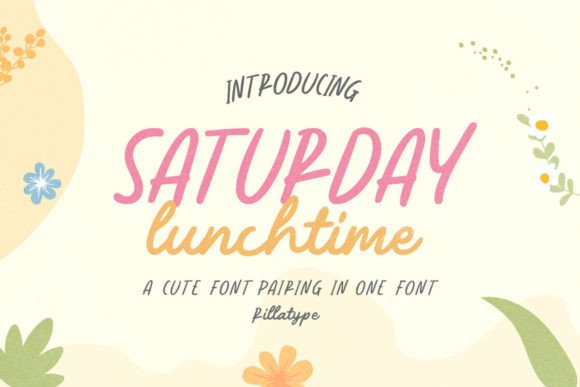
Saturday Lunchtime is a dual-style display font that combines a friendly, handwritten sans serif in uppercase letters with a soft, flowing script in lowercase. Designed with intentional contrast and visual harmony, it offers two distinct yet complementary typographic voices within a single typeface family. Unlike many script fonts that prioritize elegance or formality, Saturday Lunchtime emphasizes approachability, playfulness, and light-hearted expressiveness—making it especially relevant for designers working on projects where warmth and personality are central.
People often explore Saturday Lunchtime when they need typography that communicates joy, informality, or childlike wonder without sacrificing legibility at moderate sizes. It’s commonly considered for branding in early education, children’s products, boutique stationery, greeting cards, social media graphics, and quote-based content aimed at younger audiences or nostalgic, lighthearted themes. Its structure supports both standalone use—such as pairing uppercase headings with lowercase body text—and flexible mixing within the same line or layout.
A notable technical feature is its swash system: typing an underscore followed by 1, 2, or 3 activates alternate glyph variants for select lowercase letters. These aren’t automatic stylistic sets but manually triggered flourishes—ideal for adding subtle emphasis or customizing short phrases. This gives users fine-grained control over rhythm and charm, though it requires deliberate input rather than OpenType feature toggling in all design applications.
The primary benefit of Saturday Lunchtime lies in its duality and intentionality. Having uppercase and lowercase designed as cohesive yet stylistically distinct elements reduces the need to combine unrelated fonts—a common source of visual dissonance in playful branding. This consistency helps maintain brand voice across touchpoints, from packaging labels to digital ads. Its relatively open letterforms and generous spacing also support readability in print and on screen at sizes above 24pt, particularly in short-form contexts like logos or banners.
However, tradeoffs exist. Because it’s a display font—not a text face—it lacks the character set depth, optical sizing variants, or extensive language support found in robust text families. It does not include small caps, true italics, or extended numeral styles (e.g., old-style figures or tabular widths). Users requiring multilingual support beyond basic Latin characters—or needing to typeset long paragraphs—will likely encounter limitations. Additionally, the script lowercase, while charming, becomes less legible below 18pt, especially in low-resolution environments or when used over busy backgrounds.
Consider Saturday Lunchtime if your project centers on short, high-impact messaging where tone matters as much as information. It excels in logo design for preschools, toy brands, or indie bakeries; in Instagram story text overlays; or as a signature treatment for illustrated book covers. Its strength is emotional resonance—not functional neutrality. If your goal is to evoke curiosity, gentleness, or unselfconscious delight, the font’s aesthetic aligns well with those aims.
Conversely, alternatives may be more appropriate when clarity, scalability, or typographic versatility are higher priorities. For example, if you’re designing a full website with navigation menus, article headlines, and body copy, a versatile sans serif like Quicksand or Nunito—both friendly but more neutral and widely supported—may serve broader usability needs. Similarly, for formal invitations or luxury children’s products aiming for refined whimsy rather than casual charm, fonts like Playfair Display paired with Great Vibes offer greater contrast and typographic hierarchy without sacrificing polish.
Another practical consideration is licensing and technical compatibility. Saturday Lunchtime is typically distributed as a desktop font file (OTF or TTF), meaning web use requires proper hosting and @font-face implementation—or reliance on platforms that natively support it (e.g., Canva, Adobe Express). Not all design tools render underscore-triggered swashes identically; some may require manual glyph substitution in vector editors like Illustrator or Affinity Designer. Test rendering across your intended output channels before committing to extensive use.
Also keep in mind how Saturday Lunchtime interacts with supporting type. Its uppercase has modest stroke contrast and rounded terminals—so pairing it with a highly geometric sans (e.g., Montserrat) can feel jarring. A better match might be a warm, humanist sans like Lato or Comfortaa, which share similar x-height proportions and softness. Avoid overly condensed or ultra-light weights, as they undermine the font’s inherent friendliness.
When evaluating whether Saturday Lunchtime fits your goals, ask three questions: First, is the message brief and emotionally driven? Second, does the audience respond well to hand-drawn aesthetics and informal tone? Third, do you have the time and technical capacity to manage its manual swash system and limited character set? If the answer to all three is yes, it’s a strong candidate. If any answer is uncertain—or if your use case demands extended reading, multilingual support, or strict accessibility compliance—prioritize fonts built for those requirements instead.
Finally, remember that typography serves communication first. Saturday Lunchtime doesn’t solve design problems by itself—it supports decisions already grounded in audience understanding and strategic intent. Use it where its personality enhances meaning, not where it distracts from it. Testing mockups in real context—on actual devices, with real content length, and against background colors you’ll use—remains the most reliable way to assess fit. When aligned thoughtfully with purpose, Saturday Lunchtime delivers distinctive voice without compromising coherence.