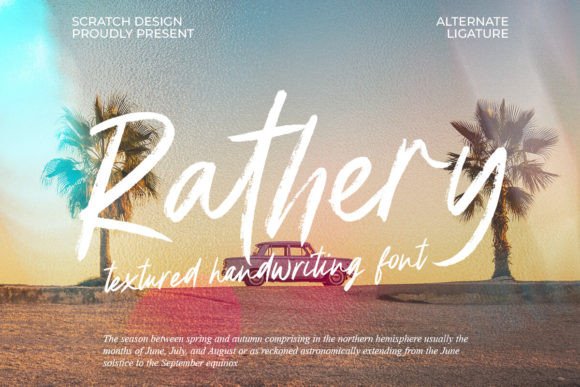
Rathery: A Textured Handwritten Script Font
If you’ve ever scrolled past a summer-themed Instagram post and paused—drawn in by the warmth, rhythm, and effortless charm of its typography—you’ve likely encountered the quiet power of a well-chosen script font. Rathery, designed by Love, is one of those rare typefaces that doesn’t just sit on the page—it breathes, sways, and invites.
It’s not a generic “handwritten” font with stiff loops or over-processed flourishes. Rathery is textured, intentional, and richly detailed—each glyph carries subtle variation in stroke weight, organic entry/exit points, and gentle irregularities that mimic real pen-on-paper movement. That’s what gives it authenticity—and why it consistently elevates designs without shouting for attention.
Why Rathery Stands Out Among Script Fonts
Many script fonts fall into two camps: overly formal (think wedding invitations with rigid copperplate) or too casual (playful but hard to read at smaller sizes). Rathery lives comfortably in the middle—structured enough for clarity, expressive enough for personality.
Its letterforms balance open counters and generous spacing, making it surprisingly legible even in body text settings—unusual for a script. The lowercase a, g, and s feature distinctive shapes that add character without sacrificing function. Uppercase letters have graceful ascenders and soft terminals, lending elegance without stiffness.
The texture isn’t simulated—it’s baked into the design. You’ll notice slight ink bleed effects, delicate tapering, and natural inconsistencies that evoke summer journaling: sun-dappled paper, relaxed handwriting, and unhurried creativity. That’s not just aesthetic—it’s emotional resonance.
Where Rathery Works Best (and Where It Doesn’t)
Rathery shines where human connection matters most: branding that feels personal, messaging that needs warmth, visuals that tell a story before a single word is read.
- Posters & Print Campaigns: Pair Rathery headlines with clean sans-serif body text for contrast that guides the eye and holds attention. Try it on eco-conscious product launches or local café menus—the texture reinforces authenticity.
- Invitations & Greeting Cards: Its relaxed rhythm suits milestone moments—baby showers, garden weddings, or community festivals—without veering into cliché. Avoid using it for fine print (RSVP details, addresses); reserve it for names, dates, and key phrases.
- Social Media Visuals: On Instagram carousels or Pinterest pins, Rathery adds visual pause. Use it for quotes, short calls-to-action (“Join Us”, “Grab Your Spot”), or seasonal banners. Its texture stands out against flat backgrounds and algorithm-driven feeds.
- Branding & Logos: As a primary logo mark, Rathery works best for service-based businesses with strong personal voices—yoga studios, boutique bakeries, independent educators, or freelance designers. Pair it with a neutral secondary font for taglines or web navigation.
- Magazines & Editorial Layouts: Editors use Rathery sparingly—but effectively—for pull quotes, section dividers, or illustrated feature headers. Its readability at 18–24pt makes it viable beyond decorative roles.
It’s less effective for dense UI elements, legal disclaimers, or multilingual layouts with extended Latin or non-Latin character sets—check the glyph coverage before committing to large-scale implementation.
Real-World Use Cases You Can Learn From
A coastal bookstore used Rathery for their summer reading campaign—hand-lettered titles overlaid on faded linen textures. Engagement on their Instagram Stories jumped 32% compared to previous seasonal posts. Why? Because Rathery didn’t just say “summer”—it felt like flipping through a well-loved paperback on a porch swing.
An online course creator teaching mindful journaling adopted Rathery for email headers and worksheet titles. Students reported higher completion rates on printable resources—attributing it to the font’s calming, unhurried rhythm helping them slow down and engage more deeply.
A small-batch candle brand paired Rathery with a light geometric sans for packaging. The contrast communicated both craft (Rathery) and clarity (sans), reinforcing their dual promise: handmade care and transparent ingredients.
Practical Tips Before You Implement Rathery
Start with licensing. Rathery is a premium font—verify whether your intended use (e.g., client deliverables, SaaS platform integration, merchandise) falls under the desktop, web, or extended license. Some creators assume “personal use” covers freelance work; it rarely does.
Test at multiple sizes. While Rathery reads well at 18pt+, avoid scaling below 14pt in digital contexts—subtle texture can blur on lower-res screens. For print, 10pt is usually the functional floor for captions or footnotes.
Pair thoughtfully. Don’t default to another script or overly decorative font. Contrast is key: try it with Inter, Work Sans, or IBM Plex Sans. These provide structure without competing. If you need a serif pairing, consider Freight Text or Scada—both share Rathery’s warmth but anchor it with typographic gravity.
Use OpenType features if available. Rathery includes stylistic alternates and ligatures—enable them in design software for richer variation. A single word like “hello” can shift from friendly to lyrical depending on which l or o variant renders.
Final Thought: Typography as Tone
You wouldn’t choose a monotone voice for a storytelling podcast. Nor should you pick a font that contradicts your message’s emotional core. Rathery isn’t about trend-chasing—it’s about aligning visual tone with human intention. When your audience sees it, they don’t just read words. They sense pace, season, sincerity.
That’s why designers return to Rathery for projects where warmth isn’t optional—it’s foundational. Whether you’re launching a wellness newsletter, designing a teacher’s classroom toolkit, or refreshing a local nonprofit’s identity, this font quietly supports your goals instead of overshadowing them.
If your current typography feels transactional rather than relational, Rathery might be the subtle shift that changes how people feel—not just what they see.