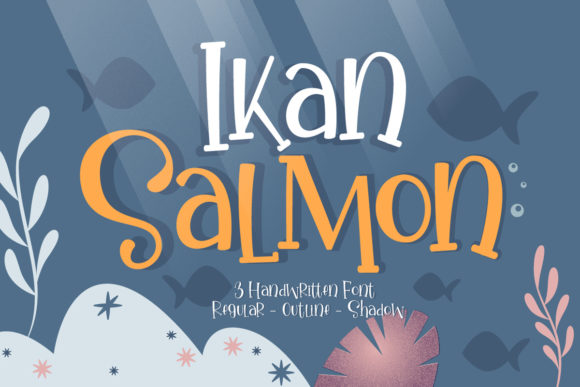
Ikan Salmon: A Handwritten Font Built for Craft and Clarity
Handwritten fonts walk a fine line—too casual, and they undermine professionalism; too stylized, and they sacrifice readability. Ikan Salmon avoids both pitfalls. It’s not a script meant for logos or headlines alone. Instead, it’s a friendly, rhythmically consistent handwritten typeface designed for real-world craft applications where warmth and legibility must coexist.
What Makes Ikan Salmon Distinctive
At first glance, Ikan Salmon feels approachable—not playful in a childlike way, but human in its imperfections. Its letterforms have gentle variation in stroke weight, subtle entry and exit strokes, and soft curves that mimic natural pen movement without excessive flourishes. Unlike many handwritten fonts that rely on heavy alternates or unpredictable ligatures, Ikan Salmon prioritizes consistency across characters. That makes it easier to set longer passages—think workshop handouts, product tags, or social media graphics—without visual fatigue.
Its PUA (Private Use Area) encoding is a practical strength. Designers using tools like Adobe Illustrator, Affinity Designer, or even modern versions of Canva can access alternate glyphs, swashes, and contextual variants directly from the glyph panel—no need for complex OpenType feature toggling or workarounds. This matters when you’re iterating quickly on packaging mockups or custom greeting cards and need to swap a “g” or “y” for a more elegant variant mid-design.
Where Ikan Salmon Performs Best
Ikan Salmon excels in contexts where authenticity and tactility matter more than formality. Consider these examples:
- Small-batch product labeling — artisanal soap makers, local coffee roasters, or ceramic studios use Ikan Salmon for ingredient lists or origin notes because it complements handmade aesthetics without looking artificially “cute.”
- Educational printables — teachers and curriculum designers apply it to worksheets or classroom posters where readability supports comprehension, especially for younger readers or neurodiverse learners who benefit from clear, uncluttered letter shapes.
- Digital course assets — freelancers building online workshops often pair Ikan Salmon with clean sans-serifs (e.g., Inter or Manrope) for headings or callouts, adding visual personality without compromising screen legibility at 16–18px sizes.
- Branded stationery — service-based professionals (photographers, wedding planners, therapists) use it sparingly on business cards or thank-you notes to reinforce personal connection without overcommitting to handwriting as a full brand identity.
Usability and Workflow Integration
Installation is straightforward: install the .OTF file, restart your design app, and it appears in your font menu. No plugins or additional software are required. The family includes one weight only—regular—which keeps things simple but also means it doesn’t scale to bold or italic variants. That’s a limitation worth noting if your projects routinely require typographic hierarchy through weight contrast. In those cases, pairing Ikan Salmon with a neutral, highly legible sans-serif (like Montserrat or Lato) becomes essential—not optional.
Spacing is well-tuned for both digital and print output. Kerning pairs are thoughtfully adjusted, so “To”, “The”, and “And” don’t collide or gap awkwardly. Tracking adjustments are rarely needed for body text under 24pt. At larger sizes—say, 48pt for a tote bag tag—the swashes add charm without overwhelming the shape of individual letters.
Quality and Long-Term Practicality
The outlines are clean and well-hinted, meaning Ikan Salmon renders crisply on screens and holds up well when printed at high resolution. There are no stray anchor points or inconsistent curve handles—common red flags in lower-tier handwritten fonts. That reliability translates into fewer last-minute fixes during client revisions or production handoffs.
It’s also lightweight: the file size is under 100KB, so embedding it in web projects via @font-face is feasible if used selectively (e.g., for hero section headings). However, it’s not optimized for web-first use out of the box—no variable axes, no WOFF2 compression included—and shouldn’t be deployed as body text on content-heavy websites.
Audience Fit: Who Benefits Most?
Ikan Salmon serves creators who value intentionality over ornamentation. It’s particularly useful for:
- Freelance designers supporting small businesses—where fast turnaround and visual coherence across multiple touchpoints (social posts, labels, email headers) are critical;
- Educators and trainers producing physical or downloadable learning materials that balance engagement with clarity;
- Small business owners handling their own branding basics, especially in food, wellness, or creative retail niches;
- Hobbyists and makers creating personalized gifts, scrapbook elements, or craft fair signage who want professional-looking results without steep learning curves.
It’s less suited for corporate identity systems requiring strict scalability, multilingual support beyond basic Latin, or environments demanding strict WCAG contrast compliance in long-form text. Those needs point toward more engineered typefaces—or thoughtful hybrid approaches where Ikan Salmon plays a supporting role rather than carrying the full load.
Realistic Recommendations for Use
Start simple: apply Ikan Salmon to short, high-impact text—names on gift tags, titles on recipe cards, quotes in Instagram carousels. Avoid setting full paragraphs in it unless line length is tightly controlled (under 40 characters per line) and leading is generous (at least 1.4×).
When pairing, choose sans-serifs with open apertures and modest x-heights. Avoid fonts with extreme geometric rigidity (like Futura) or excessive quirk (like Comic Neue), as contrast can feel jarring rather than complementary. Try it with Work Sans, Nunito, or even the system font stack (e.g., -apple-system, BlinkMacSystemFont) for clean, accessible contrast.
If you're sourcing fonts for a team or studio, verify licensing terms. While many versions of Ikan Salmon include desktop and limited commercial use, extended licenses may be required for client deliverables involving embedded fonts (e.g., in PDF templates sold on Etsy) or SaaS platforms.
Final Considerations
Ikan Salmon won’t replace your go-to serif or sans-serif—but it fills a quiet, persistent gap: the need for handwriting that feels genuine, works reliably, and doesn’t demand constant manual adjustment. It’s the kind of font you install once and reach for repeatedly when the goal isn’t to shout, but to connect. For professionals balancing craft sensibility with practical output, that consistency and calm utility make Ikan Salmon more than just another handwritten option. It’s a dependable tool—one that earns its place in the working toolkit by doing exactly what it promises, without overreaching.